Saturday, February 7, 2015

First impressions: Hultafors EDC chisel

While strolling through the hardware store the other day a new product caught my eye: The Hultafors EDC (every day carry chisel). The price was right, at about 100 kr, and I was lacking a 10mm chisel (about 3/8") so I figured it was worth a shot.
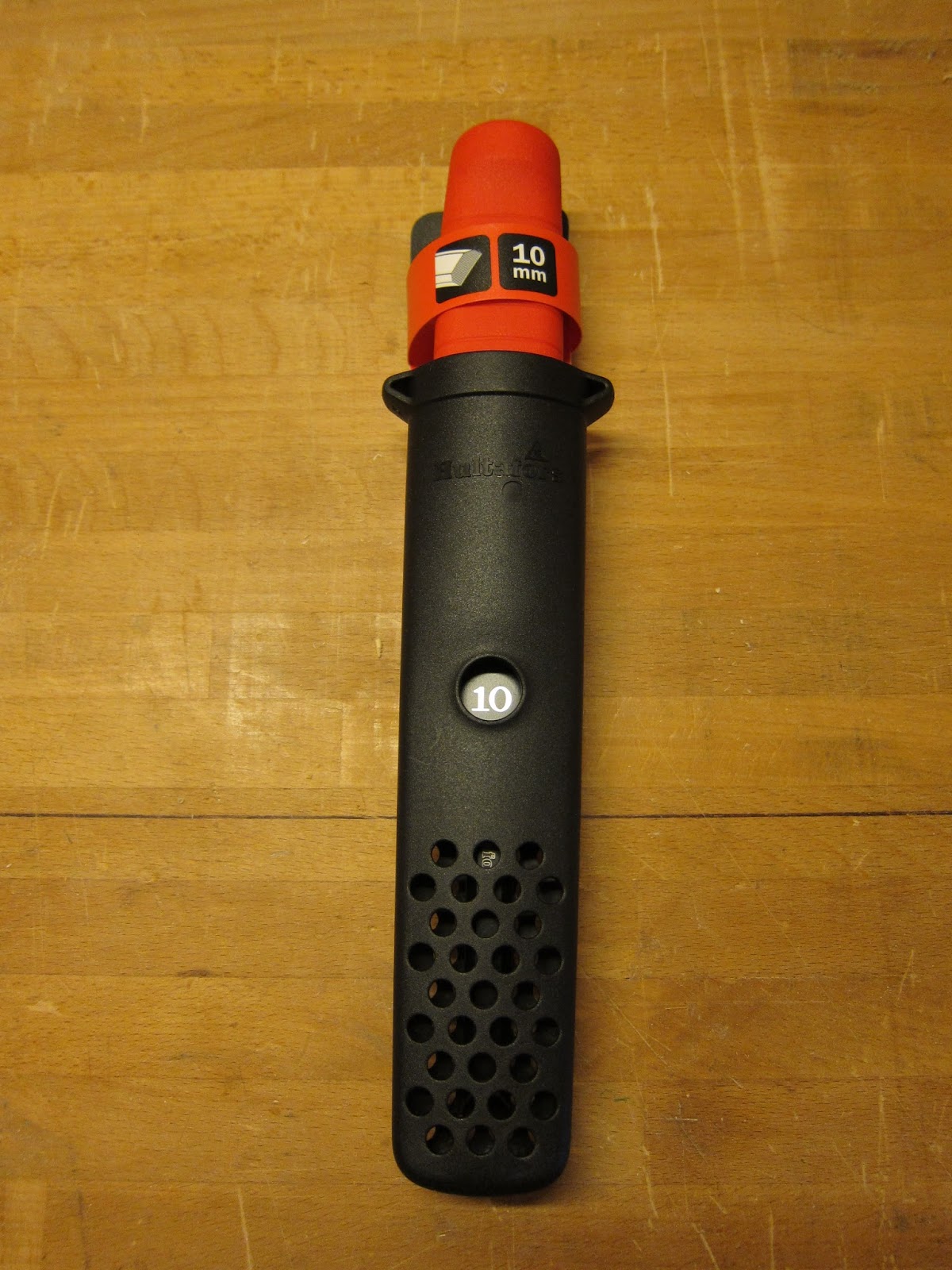

It comes in a smart holster, much like the traditional Swedish Mora knife popular with craftsmen. The coloful grips won it a design award aparently.


OK to hit it with a hammer!


As you can see, the blade is just basically stamped/forged out of 4mm sheet "Japanese carbon steel". Alarmingly, the back of the blade was coated with some sort of black paint as well as the top!


After some lapping it appears that I will be able to give it a good edge. I'll report later on its effectiveness.


For comparison with a traditional Mora knife and a "chisel knife" I found this summer. I like the fact that Hultafors is trying to sell the idea of a chisel as being a must-have tool to hang from the belt, alongside a Mora knife.

New bench appliances

An upcoming project is going to call for a lot of shooting board use, so I figured I should go ahead and make a proper one from the bench hook I've been using as a shooting board and some scrap.


Some thin plywood from a wine crate got laminated to the plywood base, and some piece of beech with predrilled holes from a forgotten piece of furniture do the trick.


This upcoming project also requires precision miters, so I scribed a line and chiseled a knifewall...


...and used a fence to aid in cutting, halfway on each side...


...and the finished piece can be used butted up against the fence.


While I was at it I made a small miter box to be used with the dozuki saw.

Tuesday, February 3, 2015

Shaker nightstand pt. 3

With the stock for the legs and apron cut and dimensioned I could start with the joinery. My experience cutting mortise and tenons by hand is limited at best, but after making eight of them for this table I feel more confident with the procedure.


The mortises were cut first, using an 8mm drill bit (first with the eggbeater, and later with the cordless) to hog out most of the material, and then cleaned with a chisel. I don't have an 8mm chisel, but made due with my 1/4" and 1". I kept them well clear of the end of the board to avoid chipping out the ends, since I didn't intend to cut these further to length.

The shoulders for the tenons were knifed in, then cut with a dovetail saw. The cheeks were cut with the same saw, and then pared down with the 1" chisel. All the tenons held well, but by the eighth they were nice and tight, without any gaps on the shoulders.


To make the top and bottom of the drawer openings on the front of the table I had to rip down the last piece of my apron stock, the ugly one with a resin pocket in the middle. I did this at the bench, standing on a stool to gain height.


Then I edge planed them with a try plane.


And planed them to the same thickness on my bench hook/shooting board.


While the bottom of the drawer opening is mortised in place, the top is held by dovetails.


The completed bottom, ready for its legs to be tapered.

Thursday, January 29, 2015

Shaker nightstand pt. 2

As luck would have it, an appropriate piece of lumber for the top and drawer front appeared in a dumpster for discarded furniture soon after starting the legs. This appears to be part of some sort of Ikea bed or sofa; where the rest of the piece went I cannot say. Under the orange-gold finish appears to be some solid beech.


I reckon there's enough material there for a top and a drawer front! And that leg looks like it could be used for the body of a small handplane...


The hardware installed on the piece meant that there were some unwanted holes on the backside that would have to be avoided. This piece of figured grain right in the middle of the piece would make an interesting drawer front, but would make chopping up the board challenging.


A bit of planing to reveal the wood beneath, and a few rough cuts later, this should work well.

Wednesday, January 28, 2015

Shaker nightstand pt. 1

With a few workshop-related projects under my belt, I was ready for the challenge of a small furniture project to test my skills and the limitations of my workspace. Thinking over my options, I decided upon a small table with mortise and tenon joinery, and a drawer with half-blind dovetails, both of which were relatively new to me but which I felt confident trying. Maybe some tapered legs, I thought... why this is sounding something like a Shaker end table. A little Googling revealed that I was far from the first to come upon this form as a good project for a starting woodworker. Hundreds of inspiration-pictures are available out there, as well as instruction pamphlets and DVDs to buy.

A walk with the dog provided a very straight-grained 2x6 off-cut from a construction site's scrap pile. It was about 110 cm long, and would provide four very nice rift cut legs, or three rift cut and one flat cut leg and some resawn boards for the apron. My thrifty side prevailed, and I decided upon the latter, and got out a file to reshape the teeth of a flea-market Sandvik cross cut saw into a rip saw.


Sometimes I do have to step out of the closet. Here's the board with some layout lines resting on my sawbench. The sawbench, based upon one I saw last summer, and the toolchest, built in a class in England, normally reside together in the bedroom.


Resawing, and all the planing dimensioning of these boards, was done back in the closet workshop.

With four serviceable legs and pieces for the apron, I began keeping my eyes peeled for an appropriate top. Some sort of hardwood with nice grain would be ideal, but I was determined to use only salvaged lumber for this build, so it would have to be something that someone else had discarded...

Tuesday, January 27, 2015

Inard CAD for Android

For the last few years I've been using the excellent Inard CAD program for Android on my phone and tablet. The app's ingenious and intuitive input system allows one to quickly create drawings of projects or spaces and share them either as printable pdf files or in formats that can be opened and modified in desktop CAD programs such as AutoCAD.

Here's an example, of a little nightstand project I have mocked up and will document in coming blog entries.

Sunday, January 25, 2015

Makers? Or people who make things?

Debbie Chachra wrote a thoughtful piece over at the Atlantic concerning the somewhat troublesome term "maker" and why creation is valued over maintenance.

Does the world really need more stuff? Cooking is great: every day one gets to be involved in a project, developing skills and a repertoire over the years. I see my woodworking as a similar endeavor: I hope to develop the skills to be able to, when needed, produce an item that fulfills a needed function with the resources at hand. Isn't that really what "making" is all about?